Here's my theory: the referees are helping teams (especially undefeated teams) win against smaller in-conference opponents. Here's why: a conference has a lot to gain by having an elite team. As much as I hate to admit it as an ACC fan, parity is not good for a conference. If a conference sends a team to the national championship game, or multiple BCS games, as the Big 10 and SEC did (remember Big 10), they make a lot more revenue for the
 big games. And with revenue sharing, the conference splits up this cash. Though slightly outdated, here's a good article that explains it all (I also find it interesting that it comes from Iowa, keep that in mind, too). Here's a quote from Iowa athletic director at the time, Bob Bowlsby, taken from the article that explains it well, "A second Big Ten team involved in a Bowl Championship Series game provides a significant boost to the conference and the member institutions in several ways including additional national recognition of the second team in particular and the league as a whole as a result of the media attention provided by the BCS and the bowl game." Extremely redundant, yes, but the quote is important.
For games in which two teams from the same conference play each other, the game is officiated by conference referees. In short, the refs are employed by the conference, itself. So, if there is a result of that game that is clearly beneficial to the that conference, what is to stop those officials from doing their best to make sure that result happens? Granted, if it's completely obvious, it's going to raise some red flags with the NCAA, but there is nothing preventing officials from making some important, questionable calls that can swing a close game.
 The reason why I developed this theory came from watching the Iowa Hawkeyes play during their undefeated run, specifically their Oct. 31 win against Indiana. Though the 42-24 final score looks like a comfortable win, it was anything but for the Hawkeyes. QB Ricky Stanzi threw 5 INTs on the day, 4 in the 3rd quarter, and Iowa trailed by 14 in that same 3rd quarter. Yet, thanks to some very questionable officiating, Iowa cruised along the undefeated road into November. It was at this play specifically, that I began to sense something fishy was going on. A clear Indiana touchdown, one that would have given them a 2 TD lead late in the 3rd, is overturned. Iowa's undefeated run came to an end the next week against Northwestern in a game in which Stanzi was injured early on and Iowa turned the ball over 4 times. Also, the Hawkeyes didn't score any points after Stanzi left in the 2nd quarter; they didn't do enough to win, even with the assistence of referees.
 Back at the beginning of the season, Michigan received a gift win over Notre Dame thanks to Big 10 officials. Keep in mind, this game took place in early September, when Michigan fans were thinking that Tate Forcier was the best thing since sliced bread and was going to lead them back to the promised land. Michigan back on top again; the Big 10 must dream about it every night. Also, this is a Big 10 team against a non-Big 10 team, officiated by Big 10 refs. Don't worry, they're definitely going to be impartial. As much as I love to see an irate Charlie Weis on the sidelines, he had some critical comments of the Big 10 refs that I had to agree with.
 I'm not accusing Iowa of any wrongdoing, I just think they may have been the benificiaries of a conference desperately seeking redemption in the bowl season with something to prove. The Big 10 did go on to prove a lot of people wrong and have a tremendous bowl season, winning both of their BCS games.
But I think this may be a problem that could be a lot more common in college football than we know about. The SEC got its dream scenario in a conference championship game featuring undefeateds Alabama and Florida. Who's to say that the SEC officials didn't give them some breaks during their seasons, paving the way toward this matchup (which did lead to the 2 teams both making, and winning, BCS bowls)? I'm not saying it happened, but it certainly could have, especially in Alabama's close win over Tennessee and Florida's over Vanderbilt.
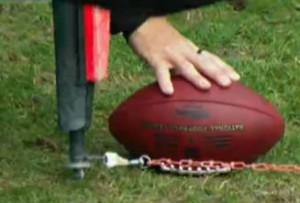 However, this theory contrasts greatly with the blatant cheating by the officials in Georgia Tech's win over Virginia Tech. VaTech was undefeated and the #4 team in the nation at the time when the officials picked up a ball that was spotted short of the first down marker, moved it forward, and awarded Georgia Tech the first down (just click on the link to watch the clip). Watching that game, I was dumbfounded. I still am, especially since it goes completely against my theory. Maybe, like everything else that happens in ACC football, it just doesn't make sense.
This may be just a theory, but there is nothing preventing my theory from happening. If it is beneficial to a conference if one team wins a certain game, and the conference employs the refs calling the game, the conference is going to tell the refs to give the breaks to the team they want to win. The only thing keeping this theory from happening is ethics, and as we all learned from the financial disasters of the past decade (take Enron and ponzi schemes), ethics is not an effective enforcer of the rules. Conferences referees are not impartial. Just letting you know, you heard it here first.


No comments:
Post a Comment